
Employment & Social Development Canada
Unifying Six Regional Offices Under a Single Process Architecture
The Challenge
A major program delivery branch was operating across six regional offices with no standardized claim processing workflow. Each region had developed its own informal procedures over years of independent operation, resulting in inconsistent decisions, compliance risk, and staff frustration. Leadership had tried to standardize before — but without a clear process map, every attempt stalled.
The Approach
Discovery & Mapping
Structured interviews with staff across all six regions. Document analysis of existing SOPs, forms, and decision logs. Built a composite picture of how the process actually ran — not how it was supposed to run.
Decision Point Analysis
Identified 14 critical decision points in the process where logic diverged by region. For each, documented the variation range, the compliance implications, and the root cause of inconsistency.
Process Model Design
Designed a unified process model with a single logic path, embedded governance triggers at high-risk decision points, and explicit escalation protocols.
Validation & Handoff
Tested the model against 40 representative historical cases across all regions. Refined based on edge cases. Delivered with implementation guide and a facilitation kit for regional rollout sessions.
“The engagement process was extremely productive and impactful.”
Director, Program Operations Branch
Employment & Social Development Canada
30%
Estimated reduction in processing variance
Outcomes
- Single standardized process adopted across all six regional offices
- 14 decision points with inconsistent logic resolved and documented
- Framework became the reference architecture for the department's 2023 digital transformation initiative
- Regional managers reported improved staff confidence and reduced escalations within 90 days of rollout
Engagement
Related Work
Service Canada
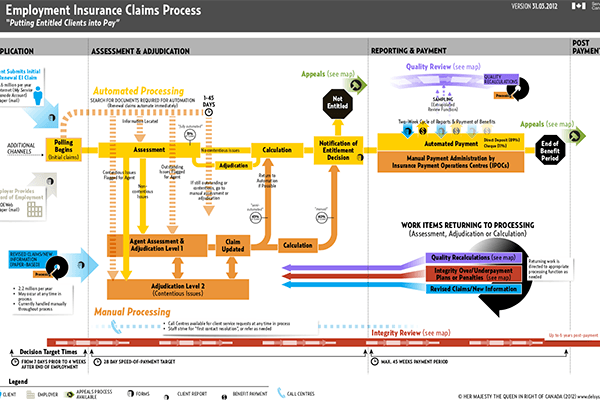
Insurance Claims Process Redesign
Process Design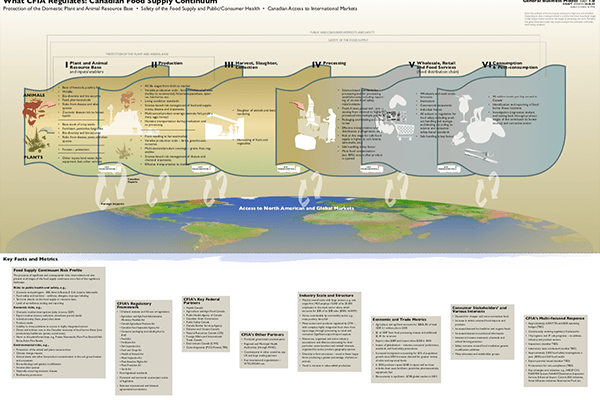
CFIA
Program & Regulatory Continuum
Process Design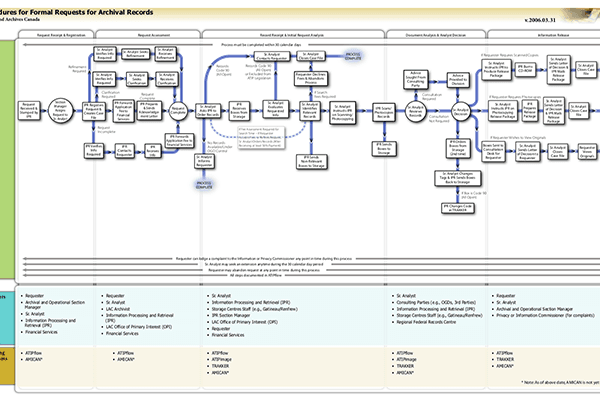
LAC
Records Management Process Architecture
Process Design